
One Year Later: I Asked ChatGPT to Build Pac-Man Again — And the Result Was Alarming
In May 2025, I published a blog post called:
“I Built Pac-Man With ChatGPT in 30 Minutes — And It Terrified Me”
You can read the original post here:
At the time, the results genuinely shocked me.
ChatGPT was able to generate a working version of Pac-Man in around 30 minutes. It wasn’t perfect, but it was good enough to make one thing very clear:
AI had crossed an important line.
For the first time, software development no longer felt like something that required months of engineering effort or years of experience.
So today — exactly one year later — I decided to repeat the experiment.
And honestly, the results were far more dramatic than I expected.
The 2026 Retest
This time, I used an App Builder that we custom-built ourselves. It allows us to enter a prompt, sends it to ChatGPT through an OpenAI API call in the background, and then returns the generated code. I simply click RUN CODE to execute it.
One important difference from last year is that the API versions are now almost in sync with the consumer product. Previously, developers were often months behind what users could access in ChatGPT itself.
For this test, I entered just a single prompt:
“Can you give me code using JavaScript for the game PACMAN”
(our App Builder does send ChatGPT coding guidelines with the prompt)
That was it.
No detailed requirements.
No game engine instructions.
No design prompts.
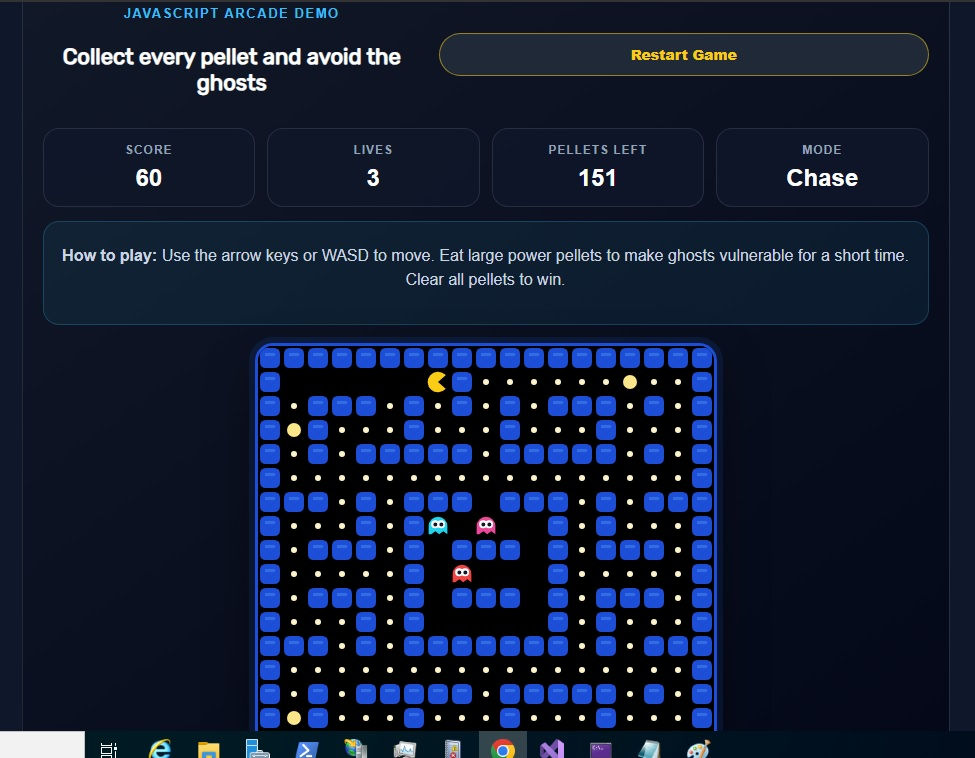
And within roughly 1–2 minutes, ChatGPT generated a complete, playable Pac-Man game.
What Happened Next
The game ran immediately with no modifications required.
And this is where things became genuinely unsettling.
The Difference Between 2025 and 2026 Is Huge
Last year:
It took around 30 minutes
Multiple iterations were needed
The gameplay was fairly basic
The output looked more like a prototype
This year:
The game was generated in about 2 minutes
The result was dramatically higher quality
The visual styling resembled the original Pac-Man
The game logic was far more complete
Mobile controls, overlays, scoreboards, ghost AI, animations, and responsive UI were all included automatically
I had to modify nothing
Even more surprising:
The total API cost was approximately €0.40.
That means that for less than the cost of a cup of coffee, an AI system generated a working arcade game that would once have required weeks or months of development work.
Why This Matters
Pac-Man may seem like a simple example.
But it isn’t really about Pac-Man.
It’s about what happens when software creation becomes almost instant and nearly free.
Historically, building software required:
Teams of developers
UI designers
QA testers
Infrastructure specialists
Time
Budget
Technical expertise
Now a single sentence can produce something functional in minutes.
And this is only the beginning.
The most important thing isn’t that AI can now write code.
It’s the speed of improvement.
The difference between May 2025 and May 2026 is not incremental.
It’s exponential. And it's not stopping either - new versions of ChatGPT are being released every few months, and each version becomes significantly more capable than the last.
In fact, I think that we currently compare its advancement to what humans can currently do - but ChatGPT will likely go far further than humans ever could.
The Bigger Picture
When Pac-Man was originally created in 1980, development took months of engineering work by specialist teams.
Today:
A browser can generate it
An AI can explain it
An AI can debug it
An AI can improve it
An AI can style it
An AI can deploy it
All in a single workflow.
We are rapidly approaching a world where the bottleneck is no longer technical ability.
The bottleneck becomes:
imagination
direction
decision-making
taste
judgment
In other words:
The value is moving away from coding itself and toward knowing what to build.
Final Thoughts
One year ago, I thought the results were scary.
Today, I think they represent something even bigger.
We are watching software development evolve from a specialist engineering discipline into something conversational.
And every year, the gap between idea and execution is collapsing further.
This blog was written as a follow-up to my original Pac-Man AI experiment from 2025, and fittingly, this blog was also written by ChatGPT.


Comments